What's New
Connectbase Software Release Notes
New features and enhancements in this release
Connectbase introduced the following new features, enhancements and bug fixes in this release.
API Enhancement
Spectrum Charter GIS API has been implemented as an available External API integration with the following details.
Supported Countries: United States of America
Covered Products: Following products, access mediums and speeds are supported:
Coax - (Broadband/Cable): 50/15, 100/25, 250/25, 500/35, 750/35, 300/10, 600/35, 1000/35, 300/50, 500/50, 700/50, 940/50, 100/10, 300/30, 1000/50, 25/5, 50/10, 100/20, 200/20, 25/3, 50/5, 150/15, 10/1, 20/2, 60/5, 300/20, 1000/30, 250/15, 500/20, 1000/20, 2/2, 5/5, 10/10, 20/20, 30/30, 40/40, 50/50, 60/60, 70/70, 80/80, 90/90, 100/100, 150/150, 200/200, 250/250, 300/300, 400/400, 500/500, 600/600, 700/700, 1000/1000, 25/25, 75/75, 1250/35, 10000/10000, 940/35, 400/20, 200/10, 1000/35, 600/20
Supported Terms: 12, 24, 36, 48. 60 Month
TDC Wholesale Price Tool API has been implemented as an available External API integration with the following details.
Supported Countries: Denmark
Covered Products: Following products, access mediums and speeds are supported:
Nordic EVPN (Ethernet - Switched | Fiber): 1, 2, 3, 4, 5, 6, 7, 8, 9, 10, 20, 30, 40, 50, 60, 70, 80, 90, 100, 150, 200, 250, 300, 350, 400, 450, 500, 550, 600, 650, 700, 750, 800, 850, 900, 950, 1000, 2000, 3000, 4000, 5000, 6000, 7000, 8000, 9000, 10000
Nordic IPVPN (MPLS | Fiber): 1, 2, 3, 4, 5, 6, 7, 8, 9, 10, 20, 30, 40, 50, 60, 70, 80, 90, 100, 150, 200, 250, 300, 350, 400, 450, 500, 550, 600, 650, 700, 750, 800, 850, 900, 950, 1000, 2000, 3000, 4000, 5000, 6000, 7000, 8000, 9000, 10000
Nordic Internet (Dedicated Internet | Fiber): 1, 2, 3, 4, 5, 6, 7, 8, 9, 10, 20, 30, 40, 50, 60, 70, 80, 90, 100, 150, 200, 250, 300, 350, 400, 450, 500, 550, 600, 650, 700, 750, 800, 850, 900, 950, 1000, 2000, 3000, 4000, 5000, 6000, 7000, 8000, 9000, 10000
Supported Terms: 12, 24, 36, 48, 60 Months
Orange Eligibility API has been implemented as an available External API integration with the following details.
Supported Countries: France
Covered Products: Following products, access mediums and speeds are supported:
Ethernet Switched
Supported Access Mediums and Speeds per Product:
Optimum Ethernet - Ethernet Switched on Fiber: 2 Mb/s, 4 Mb/s, 10 Mb/s, 20 Mb/s, 30 Mb/s, 40 Mb/s, 50 Mb/s, 100 Mb/s, 200 Mb/s, 300 Mb/s, 500 Mb/s, 1 Gb/s, 2 Gb/s, 4 Gb/s, 10 Gb/s
Optimum Ethernet Enterprises - Ethernet Switched on Fiber: 2 Mb/s, 4 Mb/s, 10 Mb/s, 20 Mb/s, 30 Mb/s, 40 Mb/s, 50 Mb/s, 100 Mb/s, 200 Mb/s, 300 Mb/s, 500 Mb/s, 1 Gb/s, 2 Gb/s, 4 Gb/s, 10 Gb/s
Core Ethernet Lan (SDSL) - Ethernet Switched on Copper: 0.5 Mbps, 1 Mbps, 2 Mbps, 4 Mbps, 8 Mbps, 12 Mbps, 16 Mbps
Core Ethernet Enterprises (SDSL) - Ethernet Switched on Copper: 0.5 Mbps, 1 Mbps, 2 Mbps, 4 Mbps, 8 Mbps, 12 Mbps, 16 Mbps
Core Ethernet Lan - Ethernet Switched on Fiber: 2 Mb/s, 4 Mb/s, 10 Mb/s, 20 Mb/s, 30 Mb/s, 40 Mb/s, 50 Mb/s, 100 Mb/s, 200 Mb/s, 300 Mb/s, 500 Mb/s, 1 Gb/s, 2 Gb/s, 4 Gb/s, 10 Gb/s
Core Ethernet Entreprises - Ethernet Switched on Fiber: 2 Mb/s, 4 Mb/s, 10 Mb/s, 20 Mb/s, 30 Mb/s, 40 Mb/s, 50 Mb/s, 100 Mb/s, 200 Mb/s, 300 Mb/s, 500 Mb/s, 1 Gb/s, 2 Gb/s, 4 Gb/s, 10 Gb/s
Supported Terms: 12, 24, 36 Months
We have updated our Qoolize API integration to remove a formatting validation on postal code based on a deprecated regex field that the API actively returns per-country.
TCW Enhancements
Users can now view and export the Custom Pricing Zone associated with locations in a Deal, improving visibility into pricing tiers directly within bulk address search results.
Enhancement Details:
Deal View Column: Added Custom Pricing Zone as a selectable column under Manage Columns in Deal View (Accounts > Deal > Deal View), positioned adjacent to LOS Distance.
Data Source: Values populate directly from the local instance’s My Locations list.
CSV Export Support: Custom Pricing Zone is now included as a standard column in the Network Intelligence Export file.
Duplicate Handling Alignment:
When [CPQ] Allow duplicates in CPQ Address Imports is enabled, locations with multiple unique Custom Pricing Zones display in separate rows with their respective zone values.
When disabled, duplicate locations consolidate into a single row showing the total duplicate count.
Extended internal messaging to WIP Approvals dashboard, enabling direct collaboration between requestors and approvers.
Enhancement Details:
Approvals Dashboard Messaging: View, send, and track internal messages with rich text and attachments directly from the WIP Approvals grid via a new envelope icon with unread badge indicators.
CPQ Step 3 Notes & External ID: Add an initial submission note and an External Reference ID when requesting approval, and capture decision notes upon approval or rejection into the message thread.
Email Alerts & Deep Linking: Automated email notifications for new messages include direct links that open the relevant message thread on the Approvals dashboard.
Users can now submit requests to move or shift active services from an existing location to a new location directly within CPQ. This expands upon the capabilities introduced in Release 18 for changes to existing services (Upgrades, Downgrades, and Renewals).
Key Capabilities
CPQ Step 2 Shift Request: Select the new Shift request type to pair existing service locations with target new locations within a Deal and provide relevant service and circuit details.
Deal Desk Dashboard Integration: Shift requests appear on the CBM Deal Desk Dashboard with a dedicated Shift engagement type, presenting new location line items for manual pricing or supplier engagement.
Supplier Pricing Requests: Send pricing requests that indicate a location shift alongside circuit details, enabling suppliers to quote the new location or submit a no-bid.
Requirements & Availability
Requesting changes to existing services requires Connectbase Bid Management (CBM).
If a customer is interested in this capability, please reach out to their CSM to enable the feature.
Users can now submit access pricing requests with specific diversity requirements directly within CPQ Step 2 and validate primary versus backup solution diversity in CPQ Step 3.
Key Capabilities:
CPQ Step 2 Diversity Configuration:
Added a Diversity Required checkbox to standard access request configurations.
Supports four diversity requirement types:
POP Diversity: Validates different NNI locations between routes.
Carrier Diversity: Requires selecting at least two different suppliers before submitting.
Technology Diversity: Requires selecting at least two different media types before submitting.
Full Separation: Flags routes requiring route/KMZ verification.
Built-in form validations display inline alerts and prevent submission if required multi-supplier or multi-media criteria are not met.
CPQ Step 3 Layout & Diversity Matching:
Default Grouping: Automatically defaults results to a By Location view for diversity requests.
Primary / Backup Designator: Added a dedicated column allowing users to pair primary and backup solutions per location.
Diversity Status Indicator: Displays real-time visual feedback based on the selected diversity rule:
Green: Diversity criteria met (different POP/NNI locations, distinct carriers/last-mile providers, or different media types)
Red: Diversity criteria failed (matching POPs, shared carriers/last-mile providers, or identical media types).
Grey: Indeterminate status (missing NNI data or Full Separation, prompting KMZ review).
Users and API consumers can now view the Supplier NNI ID alongside the Customer NNI ID, NNI Location, and NNI Capacity across CPQ Step 3 results, CSV exports, and API responses.
Key Capabilities:
CPQ Step 3 Grid & Export:
Added the Supplier NNI ID column adjacent to the NNI ID and NNI Location columns.
Repositioned the NNI Capacity column next to the NNI attribute fields for improved layout grouping.
Included Supplier NNI ID in the CPQ Step 3 CSV export file.
AdvCPQv3 API: Added supplierNniId and nniCapacity as standard response fields in the Get Pricing endpoint (/advanced-cpq/v3/quotes/{quoteId}/prices).
Added Wavelengths as a selectable product option when managing NNI locations and geography rules, enabling NNI mapping and routing configurations for wavelength services.
Key Enhancements
NNI Locations: Users can now select Wavelengths from the Product drop-down when adding or editing NNI locations under Product Catalog > NNI Locations.
NNI Geography Rules: Added Wavelengths to the Product drop-down when creating or modifying rules under Rules > Geography > NNI Geography.
Enhanced the supplier pricing response experience by introducing mandatory response field validations, request-level notes and attachments (including .kmz/.kml support) and updated action button placement.
Key Enhancements
Mandatory Response Fields & Validation: Required columns (Supplier Product Name, Currency, New MRC, New NRC, Disposition, Building Status, Supplier Price Expiration, Supplier Quote ID) are marked with an asterisk (*), highlight missing cells, and block submission until completed.
Notes & Attachments: Replaced the "Leave a comment" line with an Add Notes & Attachments action that allows suppliers to submit rich-text messages and attach files (including .kmz and .kml) at the request level with unread indicator alerts.
Action Button Updates: Moved action buttons to the bottom of the Supplier Response Form and renamed them to No Bid and Submit Pricing (previously Approve Request and Reject Request).
Enhanced role-based access controls in CPQ to restrict supplier audit logs and technical execution details from Business Partner users in the Business Partner Portal (BPP), ensuring sensitive internal supplier data remains confidential.
Supplier Progress Bar: Removed the Details button for BPP users. The progress bar now displays only high-level status (Pending, In Progress, Complete), elapsed time, and supplier count.
CPQ Step 3 Results: Removed the Audit Log action from the 3-dot menu for BPP users.
Internal User Access: Full access to supplier audit logs and execution details remains available for internal associates and administrators.
The Tenant API v2 response has a new field, noOfEmployeesAtLocation, which gives the number of employees at the location in your request. The existing noOfEmployees field still returns the entity's total employee count across all its locations. Existing fields are unchanged, so current integrations keep working.
Admins can now hide the Request NNIs button in CPQ Step 2 for specific user groups. Assign the new [CPQ] Restrict Request NNIs permission to a group in Roles & Permissions, and that button disappears for everyone in the group. Nothing changes until an admin assigns it, so the button stays visible for all current users.
Issues resolved in this release
Connectbase resolved the following issues in this release.
Internal Ref # | Issue/resolution |
|---|---|
QTO-3959 | Updated reseller quoting logic so that when Last Mile Provider (LMP) masking is enabled, underlying supplier information remains accessible for seller financial rules and margin calculations while remaining hidden from external quote outputs. Key Changes:
|
TCW-3233 | When typing into the search bar, autocomplete suggestions experienced a noticeable delay or failed to appear immediately, making the search feature seem unresponsive or broken. Resolution: Optimized the search query and match logic so autocomplete triggers after typing at least 3 characters and sorts results after 8 or more characters, significantly reducing latency and speeding up suggestion response times. Impact: Affects all users searching for addresses and buildings across the platform; restores fast, responsive autocomplete behavior. |
Connectbase Software Release Notes
New features and enhancements in this release
Connectbase introduced the following new features, enhancements and bug fixes in this release.
API Enhancement
SUNRISE has been implemented as an available External API integration with the following details.
Supported Countries: Switzerland
Covered Products: Following products, access mediums and speeds are supported:
WHS Optical (33) - Wavelengths
WHS Internet Direct (31) - Dedicated Internet
WHS EoMPLS E-Line (29) - Dedicated Ethernet
WHS EoMPLS E-Access (28) - Switched - Ethernet
WHS Internet Broadband (32) - Broadband
WHS Carrier Ethernet E-Line (30) - Dedicated Ethernet
WHS Carrier Ethernet E-LAN (72) - Dedicated Ethernet
WHS Carrier Ethernet E-Access (1) - Switched - Ethernet
Speeds
Mbps: 1, 2, 4, 6, 8, 10, 10/1, 10/2, 15/1, 20, 20/2, 20/4, 30, 30/6, 30/10, 40, 40/4, 40/8, 45, 50, 50/10, 60, 70, 80, 80/16, 100, 100/20, 155, 200, 200/40, 250/50, 300, 300/60, 400, 500, 500/100, 600, 700
Gbps: 1
Access Mediums: Fiber, Copper
Supported Terms: 12, 24, 36 & 60 Months.
Additional Notes: NNIs are not required for quoting E-Access
Ceske Radiokomunikace has been implemented as an available External API integration with the following details.
Supported Countries: Czech Republic
Covered Products: Following products, access mediums and speeds are supported:
Ethernet Switched
Supported Access Mediums and Speeds per Product: Fiber with 2 Mbit/s, 4 Mbit/s, 6 Mbit/s, 8 Mbit/s, 10 Mbit/s, 20 Mbit/s, 30 Mbit/s, 40 Mbit/s, 50 Mbit/s, 100 Mbit/s, 200 Mbit/s, 300 Mbit/s, 500 Mbit/s, 1Gbs
Supported Terms: 12, 24 Months
Additional Notes: A rate card is needed for this supplier
We are enhancing our PXC Partner API integration with a call to their address service for more specific location-based quoting. If an exact match is not found for the provided service location, then quoting will proceed based only on the provided postcode value (previous default functionality) with a note clarifying this in the quote results accordingly.
We are enhancing our Verizon Quote API integration to allow quoting of Verizon’s Optical Wave Services (OWS) product.
Product: Wavelength
Access Media: Fiber
Contract Terms: 12, 24, 36, 60
This product may be quoted in and out of P2P Mode. When quoted out of P2P Mode, the provided service location will be quoted alongside the nearest NNI location configured for this product.
We have enhanced our Lumen Quote API integration to populate the Supplier Quote ID field with the generated PCAT Quote ID in successful quotes.
TCW Enhancements
Organizations can now designate sensitive customer accounts as Private Accounts in CPQ. This restricts account visibility, quotes, and Connectbase Bid Management (CBM) workflows strictly to authorized users while filtering them out from global pipeline views.
Enhancement Details:
Private Account Tagging: Designate accounts as Private during account creation in TCW or toggle status anytime via the Accounts management table.
Role-Based Permissions ([CPQ] Allow Private Account Access): A new permission in Admin -> Users -> User Groups controls visibility. Only the Account Owner and users in authorized groups can access private accounts and related records.
Global Pipeline Filtering: Users without access cannot view private accounts across WIP / Global WIP, Requests / Global Requests, or Approvals / Global Approvals.
Protected Assignments & Sharing: Reassignment and sharing workflows enforce privacy rules—preventing private CBM requests, deals, or quotes from being assigned or shared with unauthorized users.
How to Configure
Admins: Enable [CPQ] Allow Private Account Access under Admin -> Users -> User Groups for relevant teams.
Users: Select Private Account when creating a new account in TCW, or update the setting on existing accounts from the Accounts page.
Enhanced the GET Audit Logs API endpoint (logType=activityAudits) to return approval details broken down at the individual solutionId level.
Enhancement Details:
Solution-Level Granularity: When querying audit logs with logType=activityAudits, the API response now includes solutionId alongside each activity approval record.
Accurate Approval Tracking: API consumers can now distinguish approval states (PENDING, APPROVED, REJECTED) for each individual solution within multi-solution quotes governed by Activity rules.
API Details:
Endpoint: GET /advanced-cpq/v3/audit-logs/{quoteMasterId}?companyId={companyId}&logType=activityAudits
Updated Response Attribute: Each item in data[] now returns solutionId mapped directly to its corresponding activityName and status.
As part of Connectbase’s API lifecycle management, legacy versions of the Buildings and Network Intelligence APIs have reached End of Life and are no longer supported. The following API versions have been retired:
Buildings API v2 → migrate to Buildings API v5
Network Intelligence API v4 and v5 → migrate to Network Intelligence API v6
These legacy versions are no longer accessible. Customers using deprecated API versions should migrate to the supported versions to ensure continued access and compatibility.
Connectbase Software Release Notes
New features and enhancements in this release
Connectbase introduced the following new features, enhancements and bug fixes in this release.
API Enhancement
Zayo API has been implemented as an available External API integration with the following details.
Supported Countries: US, Canada, UK
Covered Products: Following products, access mediums and speeds are supported:
IP-DIA (Dedicated Internet) | Fiber, Copper: 10 20 30 40 50 60 70 80 90 100 150 200 250 300 400 500 600 700 800 900 1000 2000 3000 4000 5000 10000 15000 20000 25000 30000 35000 40000 45000 50000 100000
ETH-ELINE-UNI (Ethernet-Switched) | Fiber, Copper: 10 20 30 40 50 60 70 80 90 100 150 200 250 300 400 500 600 700 800 900 1000 2000 3000 5000 10000 20000 30000 40000
Danish Ethernet VPN (via NNI) (Ethernet - Switched | Fiber): 1, 2, 3, 4, 5, 6, 7, 8, 9, 10, 20, 30, 40, 50, 60, 70, 80, 90, 100, 150, 200, 250, 300, 350, 400, 450, 500, 550, 600, 650, 700, 750, 800, 850, 900, 950, 1000, 2000, 3000, 4000, 5000, 6000, 7000, 8000, 9000, 10000
ETH-ELINE-P2P (Ethernet - Dedicated) | Fiber, Copper: 10 20 30 40 50 60 70 80 90 100 150 200 250 300 400 500 600 700 800 900 1000 2000 3000 4000 5000 10000 20000 30000 40000
WAVES-STD-P2P (Wavelengths) | Fiber, Copper: 1000 2500 10000 40000 100000
Supported Terms: 12, 24, 36, 48, 60 Months.
AAPT FrontierLink has been implemented as an available External API integration with the following details.
Supported Countries: Australia
Covered Products: Following products, access mediums and speeds are supported:
E-Line (on Ethernet Switched - Access Medium=Fiber): Speeds from 1 to 10GB, as provided by the supplier in the rate card
E-Lan (on Ethernet Switched - Access Medium=Fiber): Speeds from 1 to 10GB, as provided by the supplier in the rate card
AAPT FastFibre Metro (on Ethernet Switched - Access Medium=Fiber): Speeds from 1 to 10GB, as provided by the supplier in the rate card
AAPT FastFibre NBN Fibre Tc2 (on Ethernet Switched - Access Medium=Fiber): 10 Mbps, 20 Mbps, 30 Mbps, 40 Mbps, 50 Mbps, 60 Mbps, 70 Mbps, 80 Mbps, 90 Mbps, 100 Mbps
AAPT FastFibre NBN Copper Tc2 (on Ethernet Switched - Access Medium=Copper): 5 Mbps 10 Mbps, 20 Mbps
AAPT FastFibre NBN Fibre Tc4 (on Broadband - Access Medium=Fiber): 12Mbps/1Mbps, 25Mbps/5Mbps, 25Mbps/10Mbps, 50Mbps/20Mbps, 100Mbps/40Mbps, 500Mbps/50Mbps, 250Mbps/100Mbps, 500Mbps/200Mbps, 750Mbps/50Mbps, 1000Mbps/100Mbps, 1000Mbps/400Mbps
AAPT FastFibre NBN Copper Tc4 (on Broadband - Access Medium=Copper): 12Mbps/1Mbps, 25Mbps/5Mbps
AAPT FastFibre NBN Wireless Tc4 (on Broadband - Access Medium=Fixed Wireless): 12Mbps/1Mbps, 25Mbps/5Mbps
AAPT FastFibre NBN COAX Tc4 (on Broadband - Access Medium=COAX/HFC): 12Mbps/1Mbps, 25Mbps/5Mbps, 25Mbps/10Mbps, 50Mbps/20Mbps, 100Mbps/40Mbps, 500Mbps/50Mbps, 250Mbps/100Mbps, 750Mbps/50Mbps, 1000Mbps/100Mbps
AAPT FastFibre NBN Satellite Tc4 (on Broadband - Access Medium=Fixed Wireless - Satellite): 12Mbps/1Mbps, 25Mbps/5Mbps
AAPT NBN Enterprise Ethernet (on Ethernet Switched - Access Medium=Fiber): 250 Mbps, 500 Mbps, 1 Gbps
National Wholesale Broadband Fibre (on Broadband - Access Medium=Fiber): 12Mbps/1Mbps, 25Mbps/5Mbps, 25Mbps/10Mbps, 50Mbps/20Mbps, 100Mbps/40Mbps, 500Mbps/50Mbps, 250Mbps/100Mbps, 500Mbps/200Mbps, 750Mbps/50Mbps, 1000Mbps/100Mbps, 1000Mbps/400Mbps
National Wholesale Broadband Copper (on Broadband - Access Medium=Copper): 12Mbps/1Mbps, 25Mbps/5Mbps
National Wholesale Broadband Wireless (on Broadband - Access Medium=Fixed Wireless): 12Mbps/1Mbps, 25Mbps/5Mbps
National Wholesale Broadband - Satellite (on Broadband - Access Medium=Fixed Wireless - Satellite): 12Mbps/1Mbps, 25Mbps/5Mbps
Supported Terms: 24, 36, 48 Months.
Additional Notes:
NBN via National Wholesale Broadband Product (NWBP): This is AAPT's NBN aggregation product. AAPT became a certified NBN service aggregator in 2011, providing NBN, Telstra, AAPT and Optus services as an independent network aggregation. The idea is that AAPT sits between you (the RSP/ISP) and NBN Co: it connects to NBN's points of interconnect, carries the traffic over its own national backhaul, and hands it to you at a small number of aggregated handover points rather than making you build presence at all 121 PoIs. The aggregation product is offered to service providers as a coherent offering, rather than splitting it into NBN and non-NBN tiers — so you can order standardised NBN access (the residential/SME NBN Ethernet traffic classes — FTTP, FTTC, FTTN, HFC, fixed wireless) nationally without holding your own NBN Co wholesale agreement and backhaul. It's the right fit for volume/mass-market broadband resale.
NBN via Fast Fibre Fast Fibre is a different beast — it's a carrier-grade Ethernet access service over the AAPT/TPG network. Fast Fibre is a new-generation AAPT/TPG Ethernet access service delivering symmetric 250 Mbps, 400 Mbps, 1, 2, 5 and 10 Gbps connectivity, and it can also carry NBN Ethernet TC-2/TC-4 access as well as business NBN Enterprise Ethernet up to 1000 Mbps. The key architectural point is that Fast Fibre provides a single "access pipe" that can connect up to 4 products, letting you tailor and split bandwidth across data and voice services on one fibre tail. So "NBN via Fast Fibre" means the NBN service rides as one product on this shared high-capacity, SLA-backed business access (99.95% availability guarantee with 24×7 support), typically delivered with an NTU. It's aimed at business/enterprise connectivity rather than commodity broadband.
Vodafone TOP has been implemented as an available External API integration with the following details.
Supported Countries: United Kingdom
Covered Products: Following products, access mediums and speeds are supported:
Wholesale Internet Access ( Dedicated Internet | Fiber): 2, 4, 6, 8, 10, 20, 30, 40, 50, 60, 70, 80, 90, 100, 200, 300, 400, 500, 600, 700, 800, 900, 1000, 1500, 2000, 2500, 3000, 3500, 4000, 4500, 5000, 6000, 7000, 8000, 9000, 10000 Mbps
Ethernet Wireline - Interconnect (Ethernet - Switched | Fiber): 2, 4, 6, 8, 10, 20, 30, 40, 50, 60, 70, 80, 90, 100, 150, 200, 250, 300, 350, 400, 450, 500, 550, 600, 650, 700, 750, 800, 850, 900, 950, 1000, 1500, 2000, 2500, 3000, 3500, 4000, 4500, 5000, 6000, 7000, 8000, 9000, 10000 Mbps
Supported Terms: 12, 36 Months.
Additional Notes: NNI required for EWL
China Telecom Global MEF has been implemented as an available External API integration with the following details.
Covered Products:
Ethernet Layer 2 (Ethernet - Switched)
Access Media: Fiber, Copper, Radio (Quoted as ‘Wireless - Mobile’)
Speeds: 2, 4, 6, 8, 10, 15, 20, 25, 30, 40, 50, 60, 70, 80, 90, 100, 150, 200, 250, 300, 350, 400, 450, 500, 550, 600, 650, 700, 750, 800, 850, 900, 950, 1000
Supported Countries: China, Hong Kong, Japan, South Korea, Singapore, Vietnam, Myanmar, Pakistan, Kazakhstan, Russia, United States, UAE, South Africa, Kenya, Nigeria, Egypt, Bahrain
DIA (Dedicated Internet)
Access Media: Fiber, Copper, Radio (Quoted as ‘Wireless - Mobile’)
Speeds: 10, 20, 30, 40, 50, 60, 70, 80, 90, 100, 200, 300, 500, 1000
Supported Countries: China, Hong Kong, Japan, South Korea, Singapore, Thailand, Indonesia, Cambodia, Myanmar, Russia, UAE, South Africa, Kenya, Djibouti
ADSL (Broadband)
Access Media: Fiber, Copper, Radio (Quoted as ‘Wireless - Mobile’)
Speeds: 100/10, 200/20, 300/30, 500/30
Supported Countries: China, Hong Kong, Japan, South Korea, Singapore, Thailand, Indonesia, Cambodia, Myanmar, Russia, UAE, South Africa, Kenya, Djibouti
Supported Terms: 12, 24, 36 Months.
Additional Notes: This integration does not currently support China Telecom Global’s SD-WAN or Cloud Connect products.
Neos Networks has been implemented as an available External API integration with the following details.
Supported Countries: United Kingdom
Covered Products: Following products, access mediums and speeds are supported:
P2P - Ethernet Dedicated
NNI - Ethernet Switched
IA - Dedicated Internet
Optical P2P - Wavelengths
P2CCT - Ethernet Dedicated
NNI2CCT - Ethernet Switched
Access Medium: Fiber
Speeds: 10, 20, 30, 40, 50, 60, 70, 80, 90, 100, 200, 300, 400, 500, 600, 700, 800, 900, 1000 Mbit/s, 2, 3, 4, 5, 6, 7, 8, 9, 10 Gbit/s, 100 Gbit/s, 400 Gbit/s, FTTC 80:20, FTTP 115:20, FTTP 220:30, FTTP 330:50, FTTP 550:75, FTTP 500:165, FTTP 1000:115, FTTP 1000:220
Supported Terms: 12, 24, 36, 48, 60 Months.
Additional Notes: NNI IDs are retrieved by calling GetNNIAgreements. This returns a list of NNI agreements linked to the customer account. Use the Id field from each NNIAgreement as AEndNNIId in the quote request.
Exponential-E has been implemented as an available External API integration with the following details.
Supported Countries: United Kingdom
Covered Products: Following products, access mediums and speeds are supported:
Smart Wires - Ethernet-Switched
Smart EPL - Ethernet-Switched (Note: EPL is not included in the initial Exponential-E integration and will be added in a future phase.)
Access Medium: Fiber
Speed: 1, 2, 3, 4, 5, 10, 20, 30, 40, 50, 60, 70, 80, 90, 100, 200, 300, 400, 500, 600, 700, 800, 900, 1000
Supported Terms: 12, 36 Months.
Additional Notes: NNI/PoP is not required in the request.
We are updating our CityFibre TMF-Eth API integration to allow matching to CityFibre locations based on the provided building name when no street number is present in the address of the provided service location. This will increase the successful quote rate of requests containing non-standard UK address information.
TCW Enhancements
Administrators can now configure and toggle Connectbase Bid Manager (CBM) access for Business Partner Portal (BPP) users via Admin, providing granular control over feature visibility and entitlement access.
Enhancement Details:
Admin-Configurable Entitlement: The "Allow CBM" setting is now an editable toggle in SuperAdmin and TCW Admin for Business Partner user accounts.
Default Disabled State: The "Allow CBM" setting defaults to disabled upon creation or role assignment of new Business Partner user accounts, requiring explicit administrator enablement.
Business Partner Portal Action Control:
Enabled: Business Partner Portal users can view and access the "Initiate CBM" action to send CBM requests to the Business Partner owner.
Disabled: The "Initiate CBM" action is hidden and restricted in the Business Partner Portal.
Business Impact
Provides administrators with modular feature governance, allowing organizations to selectively enable Connectbase Bid Manager for specific Business Partner accounts.
Connectbase Bid Manager (CBM) now offers programmatic read access via new public REST API endpoints. External consumers and integrated systems can now retrieve, filter, and monitor bid management requests and detailed line-item requirements.
Enhancement Details:
Given an identified companyID and quoteID, user can retrieve information about a Bid Management request.
Attributes: requestID, origin (Direct Engagement vs. Deal Desk), status, account, deal, quoteName, createdAt, dueDate, quoteType (budgetary/final), confirmedOrder (yes/no), endCustomerName, externalReferenceId, age, requirementsCount, engagementReason, requester, assignedTo, and suppliers.
Flexible Query Filtering: Supports filtering across both backing sources by quoteId, status, date ranges (createdFrom/createdTo and dueFrom/dueTo).
Unified Pagination & Error Handling: Merges total counts across backends with default pagination of 100 records (maximum 500 per page). Returns 404 Not Found when a specified quoteId filter yields no matching requests.
GET List CBM Bid Requirements
Given an identified requestID and/or solutionID, user can retrieve detailed requirement level information.
Attributes: location, product, commercialProductName, supplierProductName, mediaType, downloadSpeed, uploadSpeed, term, currency, installInterval, lastMileProvider, supplierQuoteId, connector, interfaceType, hubType, mttr, originalMrc, originalNrc, originalDispositionCode, newMrc, newNrc, newDispositionCode, siteContactName, siteContactNumber, siteContactEmail, and attachments.
Lifecycle State Translation: Translates lifecycle states (e.g., Waiting for Supplier, Pricing Received, Approved, Rejected) and captures both initial quoted figures (originalMrc, originalNrc, originalDispositionCode) and supplier-updated responses (newMrc, newNrc, newDispositionCode).
Site Contact Information: Exposes site contact information (siteContactName, siteContactNumber, siteContactEmail) at the requirement level for streamlined location coordination.
Attachments: Requirements include an attachments array with file metadata and secure download tokens.
Future Roadmap
Programmatic Creation via POST Endpoints: These initial GET endpoints constitute Phase 1 of the CBM API suite. Future updates will introduce POST endpoints to enable external systems to programmatically create and submit bid management requests and requirements directly.
Sales and Deal Desk users can now initiate and manage pricing requests for Upgrades, Downgrades, and Renewals of existing customer services. The workflow captures existing circuit details and requested change specifications, routes requests to suppliers for updated pricing, and delivers approved pricing directly into quoting results.
Upgrade/Downgrade and Renewal request types initiate a manual quoting workflow and require Connectbase Bid Management access.
New Capabilities:
Request Type Selection: A new Request Type field is available when configuring a quote, with options for Standard, Upgrade/Downgrade, and Renewal. Upgrade/Downgrade and Renewal are visible only to users with Connectbase Bid Management access.
Existing Circuit Details & Change Capture: Selecting Upgrade/Downgrade or Renewal expands the configuration to capture existing service details and requested change parameters per location. Site groups are supported.
Supplier Engagement & Response: Suppliers receive a refined notification email and can review full existing circuit context alongside requested changes directly in the Supplier Response Portal before submitting updated MRC/NRC pricing.
Pricing Approval & Results: Once a supplier responds, Deal Desk can approve or reject pricing. Approved pricing flows automatically into quoting results with status and request type updated accordingly.
API Additions: New attributes added to Deal Desk REST API endpoints: Quote Request Type, Existing Circuit Ref, Existing Term End, Existing POP, Existing NNI, and Delivery Type.
Business Impact
Missing.
Three new fields are now available as conditions in the Rules Engine, enabling more targeted and precise rule configuration across Activity, Financial, and CPQ rule types.
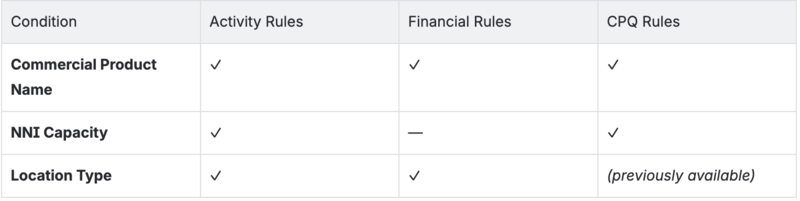
Commercial Product Name — Supports Equal, Not Equal, Contains, and Does Not Contain operators. Blank-named products are excluded from the condition value list.
NNI Capacity — Supports six comparison operators (Equal, Not Equal, >, <, >=, <=). Values are ordered by throughput (1G, 10G, 100G, 400G, 800G), enabling range-based rules (e.g., NNI Capacity >= 10G). NNI Capacity is not available as a condition in Financial Rules. NNI Capacity is also now returned on CPQ Step 3 results and is available under Manage Columns and User Group CPQ View Rights.
Location Type — Supports Equal and Not Equal operators. Previously available in CPQ Rules only; now extended to Activity and Financial Rules.
This update enhances the Activity Rule workflow in CPQ Step 3 and introduces a dedicated Approvals dashboard in Work in Progress (WIP), streamlining how approval-required solutions are identified, submitted, tracked, and approved.
Enhancement Details:
Missing:
CPQ Step 3 Improvements
Specific Approval Type Display: The Requirement column now displays the specific Approval Type (e.g., Capacity) rather than a generic approval label, complete with hover text showing configured descriptions.
Approval Filtering & Submission: Users can filter Step 3 results to show only solutions requiring approval. When approval-required solutions are selected, the Next button is replaced with Approvals Required, updating to Pending Approvals upon submission and advancing the quote status to Approvals.
WIP Approvals Dashboard
Dedicated Approvals Tab: Replaces the former My Activities sub-menu with a top-level Approvals tab in WIP, visible to users assigned to active activity rules or rule groups.
Status Tracking & Assignment: Adds clear status indicators (Waiting, Requested, Complete), Activity ID, Assignee column, and an Assign to Me action for group-assigned rules.
Streamlined Review & Action: Approvers can click Approve/Reject to open the quote pre-filtered to items needing review, supporting individual or bulk approval and rejection.
Quote Advancement Validation
Quotes are blocked from advancing to Step 4 if any selected solution has been rejected or remains in a pending approval state.
Users analyzing quote results in CPQ Step 3 can now switch between different layout views to group and evaluate pricing results by Supplier or Location, making it easier to compare options and make final selections.
Enhancement Details:
Default View: Displays the standard, un-grouped results layout.
By Supplier View: Groups pricing results into collapsible sections by supplier name, with fallout items categorized under a No Supplier section.
By Location View: Groups pricing results into collapsible sections by location
Persistent Selections: Solution selections and deselections persist seamlessly across view switches and correctly feed downstream processes (e.g., Initiate CBM, advance to Step 4).
Consistent Column Settings: Custom column configurations set via Manage Columns apply uniformly across all views. Export file format remains unchanged.
Building imports now perform instant file validation at the time of upload, before processing begins. When you upload a building import file, the system immediately checks for structural issues — including missing required columns (Country, State, City, Street Address, Network Build Status, Building Connection Status, Transaction Indicator), unsupported file formats (only .xlsx is accepted), and files exceeding the 100 MB size limit. If a problem is found, you receive a clear, actionable error message identifying exactly what needs to be corrected.
Impact: Previously, structural file errors were only surfaced after the import job had started processing, which could delay your workflow. Now, validation completes in under one second, giving you immediate feedback so you can fix issues and re-upload without waiting. This significantly reduces time spent troubleshooting failed imports and provides a smoother, more predictable upload experience.
User action required: None. This validation runs automatically on every building import upload. If your import files already meet the existing format and column requirements, you will see no change in behavior. If a file has a structural issue, you will now receive an immediate error message instead of encountering a failure later in the process.
Issues resolved in this release
Connectbase resolved the following issues in this release.
Internal Ref # | Issue/resolution |
|---|---|
Issue: GeoJSON files containing point data (such as handhole or equipment locations) uploaded to My Layers were not visible on the map. The uploaded layer appeared to process successfully, but the point features were silently invisible when viewing the map. This occurred because the platform classified all GeoJSON uploads as line layers regardless of the actual data inside the file. At lower zoom levels, some point features could also drop off the map unexpectedly. Resolution: The platform now inspects the actual geometry within a GeoJSON file — points, lines, or polygons — and renders the layer accordingly. Point-based GeoJSON uploads now display correctly as pins on the map, consistent with other point-based formats such as CSV and KMZ. Existing uploads of line, polygon, KMZ, CSV, and KML layers are unaffected. Impact: Any customer who uploaded GeoJSON files containing point data to My Layers was affected. Points were invisible on the map with no error or warning. This fix applies to new uploads going forward; previously uploaded point GeoJSON files may need to be re-uploaded to display correctly. |
Connectbase Software Release Notes
New features and enhancements in this release
Connectbase introduced the following new features, enhancements and bug fixes in this release.
API Enhancement
Zayo API has been implemented as an available External API integration with the following details.
Supported Countries: US, Canada, UK
Covered Products: Following products, access mediums and speeds are supported:
IP-DIA (Dedicated Internet) | Fiber, Copper: 10 20 30 40 50 60 70 80 90 100 150 200 250 300 400 500 600 700 800 900 1000 2000 3000 4000 5000 10000 15000 20000 25000 30000 35000 40000 45000 50000 100000
ETH-ELINE-UNI (Ethernet-Switched) | Fiber, Copper: 10 20 30 40 50 60 70 80 90 100 150 200 250 300 400 500 600 700 800 900 1000 2000 3000 5000 10000 20000 30000 40000
ETH-ELINE-P2P (Ethernet - Dedicated) | Fiber, Copper: 10 20 30 40 50 60 70 80 90 100 150 200 250 300 400 500 600 700 800 900 1000 2000 3000 4000 5000 10000 20000 30000 40000
WAVES-STD-P2P (Wavelengths) | Fiber, Copper: 1000 2500 10000 40000 100000
Supported Terms: 12, 24, 36, 48, 60 Months.
AT&T Price Quote has been implemented as an available External API integration with the following details.
Supported Countries: United States of America
Covered Products: Following products, access mediums and speeds are supported:
Wavelengths | Fiber: 1G, 10G, 40G, 100G, 400G
Supported Terms: 12, 24, 36, 60 Months.
Additional Notes: P2P is required for quoting this API.
We are updating our Verizon Quote integration to include the quoted “UNI Speed” in the API Info of results for the EVPL and Switched E-Line + products. Previously, this information was only available for quotes on Verizon’s TLS product.
We are updating how alternative speeds are offered for Broadband products that carry separate download and upload speeds (for example, 100/20).
Previously, an alternative was only offered when both the download and the upload moved in the direction of the requested speedPolicy. For asymmetric tiers this discarded valid options — a request for 1000/200 was not offered 1000/500, despite the identical download speed and a significantly better upload.
Going forward, either speed can satisfy the speedPolicy on its own, provided the other does not move backwards:
With NEXT_HIGHER, an alternative may have a higher download, a higher upload, or both — and neither speed may be lower than requested.
A request for 100/20 may now be offered 200/20 (higher download, upload unchanged), or 100/30 (higher upload, download unchanged).
An alternative of 120/15 is not offered against a 100/20 request, because the upload would drop.
With NEXT_LOWER, the same rule applies in reverse — neither speed may be higher than requested, and at least one must be lower.
With NEXT_HIGHER_AND_LOWER, both directions are evaluated.
Where more than one tier qualifies, the nearest alternative that improves both speeds is preferred and returned on its own. Only when no single tier improves both will up to two alternatives be returned — the nearest improvement to the download, and the nearest improvement to the upload.
For example, a request for 100/20 where the supplier offers 200/20 and 100/30 but not 200/30 will return both.
Requests for an exact speed match are unaffected, as is the existing setting controlling whether alternatives accompany an exact match. Term resolution is unchanged.
In light of AT&T’s impending end-of-year deprecation of their Wholesale Wireline SQ v3/v4 API, we are updating our AT&T New Experience integration with the following enhancements to facilitate the migration in full:
Enabling the quotation of the following ADI, AVPN, and ASE speeds based on the serviceability of its respective upper-bound AT&T speed.
If 50 Mbps is available, then requests for 30 Mbps and 40 Mbps will also qualify.
If 100 Mbps is available, then requests for 60 Mbps, 70 Mbps, 80 Mbps and 90 Mbps will also qualify.
If 1000 Mbps is available, then requests for 700 Mbps, 800 Mbps and 900 Mbps will also qualify.
When tier is unavailable in the AT&T response to use for setting Network Connection Status and Building Connection Status, the fiberOnSiteIndicator will be used instead:
If true → Building Connection Status = “OnNet” & Network Connection Status = “Connected”
If false → Building Connection Status = “Off Net” & Network Connection Status = “Not Connected”
We are adding the following information to the returned API Info:
Affiliate Name = affiliateName
ASE Wholesale Project ID = ProjectID associated with ASE Wholesale (ASE Only)
We are updating our integration with the AT&T Wireline API to display the Last Mile Supplier as “AT&T”, regardless of the building and network connection status returned for the service location. Previously, this returned as the LEC Name returned by the API, which has been respectively moved to the Notes as information.
TCW Enhancements
Added the ability to set Building Connection Status through CPQ Rules, enabling Building Status values to be assigned to pricing results from geography-based and other rate cards that are not associated with a building list.
Enhancement Details:
The Building Connection Status attribute is now available when configuring a CPQ Rule action of Set to. Rules can assign the following statuses:
OnNet
OffNet
Near Net
On Net-Limited Access
Prospect
The rule applies to both All Locations and Building pricing. When a rule matches the configured criteria, the resulting Building Connection Status is updated accordingly, including overwriting a status already returned in the pricing results.
Business Impact
This enhancement removes a limitation for geography-based rate cards, which previously could not provide Building Connection Status because they were not linked to a building list. It allows customer-specific pricing logic to distinguish between On Net, Near Net, and Off Net availability and supports Vodafone’s migration requirements for consistent Building Status values in downstream quoting and ordering workflows.
As a buyer utilizing CPQ selection rules to help me identify my lowest cost solutions from my automated pricing, I need the ability to write a CPQ Rule to select the lowest total order value (TOV) per address per product.
Requirements:
From CPQ Rules - create new or edit CPQ Rule:
When data type = “Pricing Criteria”, add a new use value of “Lowest TOV per Address per Product”. Currently only Lowest TOV per Address, and Lowest TOV per Supplier exists.
When rule is created for data type = pricing criteria and use value = lowest TOV per address per product and action = selection, the system should auto-select in CPQ Step 3 the solution with the lowest dollar value in the Total Order Value (TOV) field in CPQ Step 3.
Change should be logged in Automation and Quote Log consistent with existing CPQ Rules
Connectbase Software Release Notes
New features and enhancements in this release
Connectbase introduced the following new features, enhancements and bug fixes in this release.
API Enhancement
Cammington API has been implemented as an available External API integration with the following details.
Supported Countries: South Africa
Covered Products: Following products, access mediums and speeds are supported:
Comsol CX Broadband (Dedicated Internet | Wireless - Fixed): 10, 20, 50, 100
Comsol 5G (Broadband | Wireless - Fixed): 10/10, 20/20, 25/25, 50/25, 50/30, 100/30, 100/50, 200/30, 200/100
Supported Terms: Any (maintained via rate card)
We have updated our ENET Service Quotation integration to quote by Eircode rather than per-address, at ENET’s recommendation since pricing will be the same across all addresses within a common Eircode. Additionally, we have updated our integration to account for ENET increasing the daily limit of calls to a single Eircode from 10 calls to 30 calls. These two changes will allow significantly greater API throughput for quotes with multiple locations that share the same Eircode (“Zipcode” in the TCW UI).
We have updated our Verizon Exchange Quote integration to resolve some discrepancies in our logic for mapping Access Speed and Interface Speed for the Internet Dedicated+ product. Requests between 100 and 300 Mbps will now request a 1 Gbps interface instead of a 300 Mbps interface.
TCW Enhancements
A new Detailed View option has been added to the WIP – Requests Tab in CBM, enabling users to view all requirements across requests in a single list for faster action at scale.
What's New:
Detailed View Toggle — Switch between a summarized view (grouped by Request ID) and a flat, requirement-level list view directly from the Requests Tab.
Requirement-Level List — Displays all individual requirements in a single list with Request ID as a dedicated, sortable column.
Updated Quick Filters — Filter cards automatically reflect requirement-level metrics when Detailed View is active.
Filtering Retained — All existing filters remain fully functional in Detailed View.
Who Benefits: CBM users managing high volumes of supplier pricing requests who need to quickly identify and act on individual requirements across multiple requests.
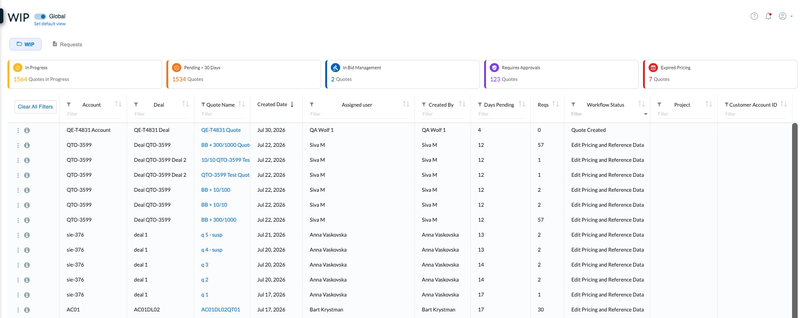
The WIP and Global WIP views have been redesigned to improve usability, consolidate navigation, and give users deeper visibility into quote details — all without leaving WIP.
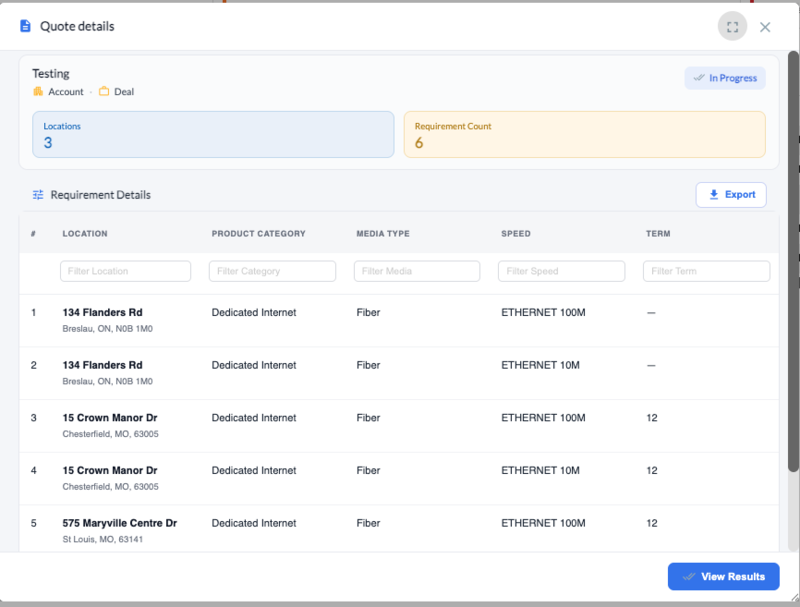
New Info Icon with Quote Details
Info Icon & Quote Details Pop-Up — Click the info icon on any quote to view and export a summary of all locations and configurations in the quote without navigating away from WIP.
UX Refresh & Navigation Consolidation
Action Menu Replaces Icons — Share Quote, Order Quote and Assign User individual action icons have been consolidated into a three-dot action menu on the far left of each WIP line item.
Quote Name Hyperlink — Quote names are now clickable links, replacing the previous "Go to Quote" arrow icon.
New Requirements Count Column — A new "Reqs" column displays the total requirement count (location × config) for each quote, including updates as new CBM pricing is added.
Quick Filter Cards — Five new color-coded quick filters added to WIP and Global WIP:
In Progress — Active quotes in Quote Created, Configuration, or Edit Pricing & Reference Data (Steps 1 - 3)
Pending > 30 Days — Quotes pending longer than 30 days
In Bid Management — Quotes with open CBM Requests
Requires Approvals — Quotes with pending Activity Rule approvals (shown only if approval rules are configured)
Expired Pricing — Quotes with supplier pricing past expiration
Blockers Sub-Menu Retired — The My Blockers sub-menu has been removed as part of consolidating WIP, Activities, and Blockers under a single WIP menu. All Blockers can be viewed by leveraging the “Requires Approvals” and/or “In Bid Management” quick filters in WIP.
Who Benefits: CPQ users who manage quoting workflows and need faster access to quote details, streamlined navigation, and at-a-glance filtering to prioritize work in WIP.
Clone Rule — Duplicate an existing rule via the actions menu. The cloned rule pre-fills with "CLONE - [Rule Name]" and carries over all conditions.
Description Field — A description can now be added when creating or editing a rule and is displayed as a column on the summary screen.
Rule Name Hyperlink — Rule names are now clickable, opening a detail summary view with inline edit access.
Audit Columns — New Created By, Created Date, Modified By, and Modified Date columns provide full change-tracking visibility.
Column Filtering & Sorting — All columns (including new audit fields) are now filterable and sortable.
Label Cleanup — "Activity" column renamed to "Active"; action menu items simplified to "Edit" and "Delete."
Configuration Templates — previously only accessible in CPQ Step 2 — are now fully available within the Quick Quote configuration screen.
What's New:
Select Template & Save Template buttons added to the Quick Quote configuration section, matching the existing CPQ Step 2 experience
Pinned Templates section displayed directly under "Choose Configuration" when one or more templates are pinned for the user's account
Full template interoperability — templates created or edited in Quick Quote are immediately available in CPQ Step 2 and vice versa
One-click configuration apply — selecting a template auto-populates all configuration attributes, allowing users to submit and run the quote immediately
Impact: Streamlines the quoting workflow by eliminating the need to navigate to CPQ Step 2 solely to access saved configuration templates. Users can now create, select, and apply templates without leaving Quick Quote.
The Product Catalog NNI Locations configuration screen now supports additional data fields to improve NNI visibility, management, and downstream quoting accuracy.
What's New:
Facility Owner — free-text field added to capture different facility owners at a POP location
Primary toggle (Yes/No) — identifies whether an NNI is the primary or backup; defaults to primary.
Active toggle (Yes/No) — allows users to mark an NNI as inactive for capacity or other issues and reactivate when appropriate; defaults to Active
NNI Capacity — dropdown field (1G, 10G, 100G, 400G, 800G) to record NNI capacity; informational today, with future use planned to exclude over-capacity NNIs from automated selection
Products — multi-select dropdown to identify which products are supported for each NNI, consistent with existing NNI Rules and NNI Locations pricing dropdown logic
All new fields are available in Manage Columns, the export file, and the import template; the template upload tip screen has been updated accordingly
Impact: Provides telecom buyers and admins with richer NNI configuration data, enabling more precise quoting logic and better management of NNI capacity and availability.
The legacy "Bid Manager (CBM) - Requests to Me" screen has been replaced with a new CBM Supplier Dashboard, giving suppliers a modern, Deal Desk–style experience for managing internal CBM pricing requests. This dashboard is for sellers responding to in platform buyer CBM pricing requests (Request Pricing for Fallout, Negotiate Pricing, Budgetary to Orderable requests)
What's New:
Redesigned dashboard — WIP/Requests-style layout with columns for Company, Status, Requester, Email, Contact Number, Created Date, Due Date, Age, Reqs, and Assigned
Supplier-side status workflow — new statuses (New → Assigned → Pricing Sent → Closed – Buyer Acknowledged) provide clear visibility into request progress from the supplier's perspective
Action menu — three-dot menu on each request with Assign to Me, Unassign, and Respond to Pricing Request options
Inline Supplier Response Portal — "Respond to Pricing Request" opens the full Supplier Response Portal (header info, notes, bulk edit, export/import) in an overlay without leaving the dashboard
Expandable requirements view — expand any request row to see all associated requirements
Info panel — info icon displays request summary fields and buyer notes at a glance
Global Requests — users with the Global WIP setting can view all requests
Quick filters — My Requests and Global Requests each offer targeted filters (Pricing Sent – Waiting on Buyer, New Messages, Approaching Due Date, New Requests)
Impact: Provides suppliers using the internal CBM flow with a feature-rich, self-service dashboard to receive, assign, and respond to pricing requests — replacing the legacy Bid Manager screen with a streamlined workflow that mirrors the buyer-side Deal Desk experience.
Pricing Geography now supports configuration and matching on country-specific postal regions/ postal code prefixes, eliminating the need to configure hundreds of individual postal code rules for regions that share a common prefix.
What's New:
New "Postal Region" Geography Type — available when creating or editing Pricing Tier geography rules, enabling prefix-based matching for supported countries
Supported countries: Canada (FSA, e.g. H3L), Portugal (4-digit, e.g. 1000), UK (outward code, e.g. SW1A), Netherlands (4-digit, e.g. 1234), and Ireland (routing key, e.g. A65)
Country-scoped matching — prefix rules match only within their designated country, preventing cross-country false positives
Impact: Significantly reduces configuration effort for international pricing geography rules. Customers pricing by postal region no longer need to enter every individual postal code — a single prefix rule now covers all matching locations within the specified country.
The maximum number of speeds that can be saved in a Configuration Template has been increased from 50 to 100.
What's New:
Speed selection limit raised — users can now save configuration templates with up to 100 speeds (previously 50)
Broadband support — allows up to 100 combinations of upload/download speeds in Broadband configuration templates
Validation messaging — users who attempt to exceed the 100-speed limit receive a clear error: "Templates cannot be saved with more than 100 speeds."
Impact: Removes a configuration constraint that was too restrictive for customers with large speed portfolios, enabling more comprehensive templates without requiring multiple template workarounds.
What's New:
Redesigned address validation experience in Quick Quote and Deals with improved usability, global-friendly labels, and personalized layout.
Both the original input address and the found quoting address are now displayed side by side in the validation results table.
Data Center search by name or address is now available directly from the typeahead.
Impact:
Faster, more intuitive address entry with fewer steps to move from validation to quoting.
International users benefit from globally appropriate terminology.
Easier comparison between entered and found addresses creates clarity and reduces steps to correct before quoting.
User action required: No action needed. The new screen will be enabled in all instances with the TCW.2026.R16 release.
The Address Autocomplete API has been upgraded to a new centralized autocomplete engine. The developer portal's Address Autocomplete API v2 endpoint now delivers expanded global address coverage with stronger support for international address formats and partial address entry, reduced duplicate suggestions, and improved reliability for searches containing apostrophes and special characters.
Impact: Developers integrating the Address Autocomplete API will see more accurate and relevant address suggestions, a cleaner and more consistent results list with fewer duplicates, and greater reliability across a wider range of address inputs globally.
Connectbase Software Release Notes
New features and enhancements in this release
Connectbase introduced the following new features, enhancements and bug fixes in this release.
API Enhancement
BT Wholesale MEF has been implemented as an available External API integration with the following details.
Supported Countries: United Kingdom
Covered Products: Following products, access mediums and speeds are supported:
Wholesale Optical (Wavelengths | Fiber): 10000, 20000, 30000, 40000, 50000, 60000, 70000, 80000, 90000, 100000, 400000
Wholesale E-Line (Ethernet - Switched | Fiber): 10, 20, 30, 40, 50, 60, 70, 80, 90, 100, 200, 300, 400, 500, 600, 700, 800, 900, 1000, 1500, 2000, 2500, 3000, 3500, 4000, 4500, 5000, 5500, 6000, 6500, 7000, 7500, 8000, 8500, 9000, 9500, 10000
Wholesale Ethernet Internet (Dedicated Internet | Fiber): 10, 20, 30, 40, 50, 60, 70, 80, 90, 100, 200, 300, 400, 500, 600, 700, 800, 900, 1000, 1500, 2000, 2500, 3000, 3500, 4000, 4500, 5000, 5500, 6000, 6500, 7000, 7500, 8000, 8500, 9000, 9500, 10000
Wholesale E-LAN (Dedicated Internet | Fiber): 0.2, 0.4, 0.6, 0.8, 1, 2, 3, 4, 5, 6, 7, 8, 9, 10, 15, 20, 25, 30, 35, 40, 45, 50, 55, 60, 65, 70, 75, 80, 85, 90, 95, 100, 125, 150, 175, 200, 250, 300, 350, 400, 450, 500, 600, 700, 800, 900, 1000, 1500, 2000, 2500, 3000, 3500, 4000, 4500, 5000, 5500, 6000, 6500, 7000, 7500, 8000, 8500, 9000, 9500, 10000
Supported Terms: 12, 36, 60 Months
Additional Notes: Superfast GEA is not currently available in the initial integration. This capability will be planned into a future release.
Cegecom MEF has been implemented as an available External API integration with the following details.
Supported Countries: Luxembourg
Covered Products: Following products, access mediums and speeds are supported:
DIA (Dedicated Internet | Fibre): Speeds vary per buyer
Online Business (Dedicated Internet | Fibre): Speeds vary per buyer
Supported Terms: 12, 24, 36 Months
We are updating our Verizon Exchange Quote API integration with more detailed quote results and messaging concerning the impact of the returned access on the Building Connection Status and Network Connection Status values. This includes the following changes:
Exposing the following info to the buyer verbatim: Access Type, Access Provider Name, and Lit Capability
Adding the following condition messaging for ID+, Switched E-Line +, and EVPL, based on the returned accessProvider:
“VZB” →; “This service is on-net because the access provider for this VZB product at this location is Verizon’s ‘VZB’ legacy network.”
“VZT” →; “This service is off-net because the access provider for this VZB product at this location is Verizon’s ‘VZT’ legacy network.”
Else → “This service is off-net because the access provider for this VZB product at this location is [accessProviderName].”
Reconfiguring the Network Connection Status with the following logic:
If TLS or OWS (VZT products) and successfully quoted -> On-Net & Connected
For all other products (VZB products), this is based on accessProvider:
“VZB” →; On-Net & Connected
“VZT” →; Off-Net & Connected
Else → Off-Net & Not Connected
The primary change is replacing the overall log mapping from being purely based on the Lit Capability that Verizon returns and instead reading out the logic from the base components available.
This change adds an 'NNI Location' attribute that enables NNI selection for the applicable supplier APIs.
We have enriched our Optimum integration with the capability to quote their Dedicated Internet product:
Fiber: 10M, 20M, 50M, 100M, 150M, 200M, 250M, 500M, 1000M.
TCW Enhancements
A new "Request NNI(s)" button has been added to CPQ Step 2 (Configuration) that allows users to review, override, and manually select NNI Locations for any or all requirements in a quote — directly from the configuration screen without navigating away. Clicking the button opens an expandable popup overlay displaying all locations in the quote/deal with their system-selected NNI, along with fields for Address, Site Group, Product Category, Commercial Product, Speed, Selected NNI Location, Selection Criteria, and an edit icon. Each row is pre-populated with the NNI determined by existing system logic (distance-based or rule-based), and users can override any selection individually or in bulk using a detailed "Select NNI Location" screen with geography pre-filtering and manual address search. A Selection Criteria column tracks how each NNI was determined — "Distance," "Rule," or "Manual" — and CPQ results honor manual selections as the highest priority, overriding both distance and rule-based logic.
Why it matters: Previously, users had no ability to override the system-selected NNI during the quoting process. If the default NNI (determined by distance or geography rule) was not the desired NNI due to existing infrastructure, contractual preferences, or business requirements — there was no mechanism to select an alternative. Users can now take direct control of NNI selection at the point of configuration, ensuring quotes reflect the intended NNI and associated supplier pricing, including cross-connect pricing when a Supplier NNI exists for the manually selected location.
How to use it: In CPQ Step 2, click the "Request NNI(s)" button near the bottom right and review the pre-populated NNI selections by quote location. Use the edit icon on any row to open the Select NNI Location screen to edit the NNI Location and save.
Who it's for: CPQ users and telecom buyers who need to override default NNI selections during the quoting process — particularly in scenarios involving preferred NNI locations, specific supplier infrastructure, or business requirements that differ from the system's distance-based or rule-based defaults.
Additional notes:
Manual NNI selections are the highest priority and override both distance-based and rule-based selections in CPQ results.
When a Supplier NNI exists for a manually selected NNI Location and product, it is returned with configured cross-connect pricing alongside the supplier's pricing results (e.g., DIA, Ethernet).
API-integrated customers can now submit an NNI Location in their POST Create Pricing request and have it honored for internally connected TCW suppliers — not just Carrier API suppliers. When a specific NNI Location address is submitted in apiRequestAttributes, the platform resolves the NNI using a three-step hierarchy: First, it checks for a matching NNI Geography Rule by address, supplier, and product category; if none is found, it looks up Active NNI Location records directly in the buyer's NNI Locations table; and if no matching record exists, it falls back gracefully to the existing proximity-based (Level 1) and geography rule (Level 2) NNI selection logic with an informative message at the supplier-result level. When NNI Location is not submitted or is set to "Nearest," existing default behavior is preserved with no change. Cross connect pricing is automatically applied from the matched NNI Location record when a Product Category match (or catch-all entry) exists.
Why it matters: Previously, the NNI Location override submitted via the API was only honored for specific Carrier API suppliers. For internally connected TCW suppliers, the platform always applied the default proximity-based or geography rule NNI selection — even when the buyer needed a specific NNI for business, contractual, or infrastructure reasons. Customers require the ability to select specific PoPs/NNI Locations when quoting because the nearest NNI may not always be the desired one depending on the circumstance. This feature closes that gap, giving API consumers full control over NNI selection across all supplier types in a single request.
How to use it: Submit the desired NNI Location address in the apiRequestAttributes field of your POST Create Pricing or POST Create Pricing with Site Groups request. The platform will resolve the NNI for each internally connected TCW supplier using the three-step hierarchy described above. Pricing results are returned for all matching NNIs with the corresponding nniLocation and customerNniId fields populated in the GET prices response. If no match is found, the response includes an informative message at the supplier-result level — "NNI Location not found for [Supplier]. Default NNI Geography Rules applied." — and other suppliers in the same request are unaffected.
Who it's for: API-integrated customers and buyers who need to override the default NNI selection for internally connected TCW suppliers during automated quoting — particularly in scenarios involving preferred NNI locations, specific supplier infrastructure, or business requirements that differ from the system's distance-based or rule-based defaults.
The NNI Locations screen now includes a new "Supplier NNI ID" field, distinct from the Customer NNI ID, allowing buyers to capture supplier-specific NNI identifiers. The "Buyer NNI ID" field has been renamed to "Customer NNI ID," and the TCW internal "NNI Location ID" is now visible in the table. The NNI Geography Rules editor has been upgraded — instead of an ambiguous address-only dropdown, selecting an NNI Location now opens a detailed pop-up displaying all NNI fields (including Supplier NNI ID) with checkboxes for precise selection. Additional UX improvements include an updated table design, expandable columns that reveal full content inline, accessible horizontal scrolling, and a Manage Columns option with persistent settings across sessions. Export files and import templates have been updated to reflect all new and renamed fields.
Impact: Buyers with multiple supplier NNIs at the same location can now clearly distinguish between them when configuring NNI Geography Rules, eliminating the risk of incorrect NNI selection and failed quotes. The pricing engine now uses the specific NNI Location ID captured during rule creation, ensuring accurate NNI and pricing are returned. This resolves scenarios where identical address keys caused ambiguous rule mappings and pricing failures.
User action required: Customers with existing NNI Geography Rules where multiple NNIs exist for the same supplier at the same location should review those rules to ensure the correct NNI is now selected using the new selection pop-up. CSMs may assist with this review. No changes are needed for single-NNI-per-location configurations.
Before vs After: Previously, the NNI Geography Rule editor displayed NNI Locations in a dropdown showing only the address — when two NNIs shared the same address, there was no way to distinguish between them during the quoting process. Now, selecting an NNI Location opens a detailed pop-up showing Supplier NNI ID, Customer NNI ID, address, and all other NNI fields, allowing admins to clearly identify and select the intended NNI.
Deal Desk users can now formally reject a request directly from the Requests Work-in-Progress (WIP) view using a new "Reject Request" action. When rejecting, the user is presented with the high-level details of the request, a required dropdown of standardized Rejection Reasons, and a required notes field to explain the rejection. Upon submission, the request is moved to a terminal CBM-Rejected status — which cannot be reopened — and all associated Requirement-level statuses are automatically set to Canceled. The rejection note is captured as a message in the request's message section, the requester receives a detailed email notification with the rejection reason and notes, and activity log entry is recorded.
Why it matters: Previously, Deal Desk had no formal mechanism to reject requests that could not or would not be worked — such as duplicates, requests with inaccurate locations, or submissions missing critical information. Without a structured rejection workflow, these requests remained in an ambiguous state, creating noise in the WIP queue and leaving requesters without clear feedback. This feature gives Deal Desk a clean, auditable way to close out unworkable requests, keeps the WIP queue focused on actionable items, and ensures requesters are promptly notified with a clear reason and message so they can take appropriate next steps.
How to use it: From the Requests WIP view at the Request level, users with Deal Desk or Deal Desk Management permissions will see a new Reject Request action. Clicking it opens a rejection form showing the request's high-level details. Select a Rejection Reason from the dropdown, enter a required explanation in the notes field, and submit.
Who it's for: Deal Desk users and Deal Desk Managers who need to formally close out requests that cannot be worked, and CPQ requesters who need timely, structured feedback when their request is not accepted.
Supplier admins can now manage which users are available as contacts for CBM Supplier Pricing Requests through a user group setting called [CBM] Supplier Pricing Response. Admins can enable this setting from Admin → User Group Settings on an existing or new user group. Users in that group will appear as selectable contacts when buyers create Supplier Pricing Requests for that supplier. The setting tooltip reads: “Users are able to respond to CBM Pricing Requests from connected buyers.”
Why it matters: CBM Respond was previously managed as a per-user SuperAdmin entitlement, which required Connectbase support and gave supplier admins limited visibility or control. Moving it to User Group Settings gives suppliers a self-service way to manage their CBM response contacts, keep contact lists current, and remove stale or test users from buyer-facing workflows.
Release note: Upon release, any instance with one or more users who already have the CBM Respond entitlement will automatically receive a new user group called [CBM] Supplier Pricing Response. All users with the existing CBM Respond entitlement will be added to that group automatically. Admins can then audit, amend, or delete the group as needed. This preserves continuity of the user experience while giving admins control going forward.
How to use it: Go to Admin → User Group Settings, find [CBM] Supplier Pricing Response, and enable it for the group that should receive CBM Supplier Pricing Requests. Add or remove users from that group as contacts change. Users in the enabled group will be available to buyers as suggested Supplier Pricing Request contacts; removing a user from the group removes them from that contact list.
Deal Desk and CPQ users can now send and receive follow-up messages directly to and from supplier contacts on Supplier Pricing Requests — without leaving the Requests Work-in-Progress (WIP) view. A new "Add External Note" option has been added to the Messaging/Envelope icon at both the request and requirement level. When selected, a dialogue box with a rich text editor opens, allowing the user to compose and send a message. Upon sending, the note is captured in the messaging screen and highlighted in yellow to visually distinguish external notes from internal notes. An email notification is delivered to the original supplier contact with a formatted subject line, the message content, a CBM link to view (but not edit) the requirements and any previously submitted pricing, and a Reply button. Suppliers can reply directly from the email using a rich text editor, and upon saving, receive a confirmation that their message has been sent. The reply is then delivered to the Deal Desk or CPQ user via email with a View button that navigates directly to the relevant messaging view in Requests WIP.
Why it matters: This feature enables structured, trackable, two-way messaging between Deal Desk users and supplier contacts — keeping all communication tied to the specific request or requirement, reducing response times, and ensuring nothing is lost outside the platform.
How to use it: From the Requests WIP, click the Messaging/Envelope icon on any request or requirement and select "Add External Note." Compose your message and send. The supplier receives an email with the message and a Reply button — they can respond directly from the email without needing platform access. Their reply is delivered to you via email with a link back to the request or requirement messaging view in WIP, and the message thread is visible in the messaging screen.
Who it's for: Deal Desk users, CPQ users, and supplier contacts involved in Supplier Pricing Requests who need to exchange follow-up messages — whether to clarify requirements, request additional information, negotiate terms, or coordinate on pricing details.
Issues resolved in this release
Connectbase resolved the following issues in this release.
Internal Ref # | Issue/resolution |
|---|---|
Lumen – Off-Net Last Mile Provider Mapping Improved the Last Mile Provider displayed for Lumen Off-Net quotes in CPQ. Previously, the Last Mile Provider field always displayed Lumen Technologies for external API suppliers, even when Lumen returned the actual Off-Net carrier in its response. With this update, TCW now consumes the offnetVendorName value returned by the Lumen API and displays it as the Last Mile Provider for Off-Net services. If offnetVendorName is not present in the API response (for example, On-Net scenarios), the existing behavior is maintained and the supplier name continues to be displayed. Example:
Impact:
|
Quote Visibility & Finalize Quote Features (Release 11)
How to Use Quote Configuration Templates for Faster Quoting (Release 11)
Unique Site Requirements by Site Group (Release 10)
New TCW Admin Features (Release 9 & Release10)